VIN Search & Plate Lookup
- 3.9
- Rating
- 10.00K
- Installs
- Free
- Price
 Analysis by App-foxy
I spent time with VIN Search & Plate Lookup as an everyday vehicle-information tool, and my first impression is that it aims to solve one very specific problem: turning a vehicle identification number into readable details without making the user work through a complicated research process. It sits in the Auto & Vehicles category, comes from PublicRecords, and is available free of charge. That makes the decision to try it easy, especially if you are checking a car before a viewing or simply want to identify an unfamiliar vehicle.
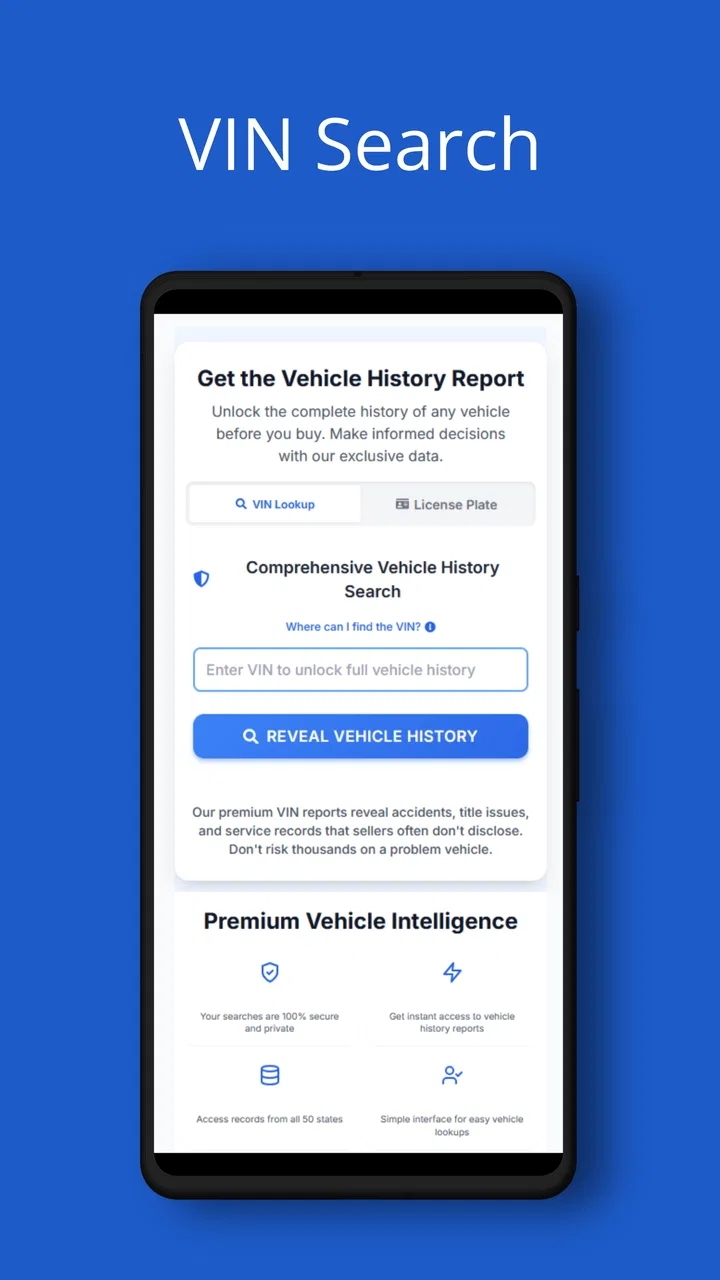
The app is built around two related searches. A VIN can reveal vehicle details in a more organized way than manually searching the number, while a plate lookup is intended to provide owner-related information where the relevant results are available. That distinction matters. A VIN is tied to the vehicle itself, whereas a plate is associated with registration and ownership records. I found that thinking of the two searches as separate research steps helps avoid expecting one lookup to answer every question about a car.
How VIN Search & Plate Lookup fits into a real vehicle check
The most useful way to approach this app is as an early screening tool, not as a complete replacement for a professional inspection, official paperwork, or a full vehicle-history service. If I were considering a used car, I would use it before spending time arranging a viewing. A quick VIN search could help me confirm that the basic vehicle identity makes sense, then a plate search could add another angle when I needed to investigate registration-related information.
You May Also Like

 Blood Strike: 2.5 Anniversary
Blood Strike’s Loadouts Turn Every Drop Into a Tactical Gamble
A close look at Blood Strike’s custom loadouts: how fast access to signature weapons reshapes its battle royale rhythm, rewards preparation, and narrows the gap between fights.

 Pandora - Music & Podcasts
Pandora’s Music Is Easy to Start, but Harder to Recover
Pandora’s strength is its low-effort path from a seed to a station. Its weak spot is how much confidence it asks you to place in connection, setup, and quiet recovery.

 8 Ball Pool
 Is Built on Rivalries, Rematches, and Routine
A close look at the rivalries, rematches, shared routines, and unanswered safety questions that turn a quick pool match into a persistent mobile community.

 Samsung Music
’s Quiet Strength Is Playing What You Already Own
Its reach comes less from spectacle than from dependable access to a personal library. That simplicity is both the app’s strongest retention engine and its ceiling.

 AccuWeather: Weather Radar
AccuWeather Review: A Quick, Clear Forecast for Everyday Decisions
For everyday plans, the best forecast is the one you can understand quickly. AccuWeather makes rain timing, radar, and local conditions easy to act on, with a few trade-offs.

 Hill Climb Racing
Why Hill Climb Racing Still Turns Crashes Into One More Run
A tiny car, a bumpy hill and one more upgrade: Hill Climb Racing keeps resurfacing because its simple chaos makes every near-miss feel personal.
More From Our News Desk



That workflow is more practical than opening a general web search and trying to interpret scattered results. A VIN is a long, error-prone sequence, so having a dedicated place to enter it reduces the chance of mixing it with unrelated numbers. My advice is to copy the VIN carefully from the vehicle or its documents, then compare the returned details with what the seller has told you. A mismatch should not automatically prove wrongdoing, but it is a clear reason to pause and ask questions.
The app is particularly relevant during the short period before buying a used vehicle. Sellers often provide several details at once, and it is easy to focus on mileage, appearance, or price while overlooking whether the vehicle identity is consistent. Running the identification number first gives me a basic reference point. I can then use that reference when deciding whether a more expensive history report, mechanic’s inspection, or direct conversation with the seller is worthwhile.
There is also a quieter use case for people who manage more than one vehicle. If you are sorting paperwork, preparing a sale, or trying to identify a car from an old record, a focused VIN tool can be more convenient than repeatedly searching through unrelated websites. The benefit is not that it replaces every automotive resource; it is that it gives the initial lookup a clear home.
What the free access means in practical terms
VIN Search & Plate Lookup is free, so there is no purchase decision standing between a curious user and the first attempt. That is its clearest value advantage over services that ask for payment before letting you explore their workflow. I could recommend starting here when the goal is simply to see whether a VIN or plate produces useful information before committing money elsewhere.
Free access should still be judged by the result, not just by the absence of a charge. A lookup is valuable when it helps confirm an identity, exposes an inconsistency, or tells you that further checking is justified. It is less valuable if you expect a complete ownership history, a definitive mechanical assessment, or a legally conclusive report from one search. I would not treat the word “free” as a promise that every record connected to a vehicle will appear.
That is an important trade-off when comparing this app with paid vehicle-history alternatives. A paid report may be the better choice when a purchase is serious and the cost of missing a major issue is high. The free app makes sense as a first filter, particularly before you have decided whether a specific car deserves deeper research. In other words, its value is strongest at the beginning of the decision process rather than at the final signing stage.
The app’s age rating is Everyone, which matches the straightforward nature of its purpose. It is not presented as a game or a specialist workshop system. I see it as a general-purpose reference tool for drivers, prospective buyers, families helping someone shop for a car, and anyone who needs to make sense of a vehicle identifier.
Where the app saves time—and where it cannot do the job for you
The main time-saving feature is the focused search experience itself. Instead of treating a VIN as an ordinary web query, the app gives it a dedicated automotive context. That makes the first step less intimidating for someone who does not know which databases or terminology to use. The same applies to plate-related research: the user can begin from the registration identifier rather than trying to guess which public-record source might be relevant.
One useful habit is to run the same vehicle information in stages. I would begin with the VIN, record the core vehicle details, and only then use the plate if I had a legitimate reason to check registration-related information. Keeping those steps separate makes discrepancies easier to notice. If a plate result does not line up with the vehicle details, I would verify the characters and the source documents before drawing conclusions.
Another practical tip is to treat the output as a prompt for better questions. If the vehicle details differ from the advertisement, ask the seller to explain the difference. If the search supports the basic identity, continue with the checks that an app cannot perform, such as examining the body, starting the engine, reviewing maintenance records, and arranging an independent inspection. The app is most useful when it improves the next decision rather than pretending to make the whole decision.
Plate-related information also needs careful handling. Owner information can be sensitive, and a search result should not be treated as permission to contact, confront, or investigate a person outside a legitimate purpose. I would use that part of the app only for lawful, responsible vehicle research. For a buyer, the relevant question is whether the information helps validate a transaction—not whether it encourages curiosity about someone else’s private details.
My experience with the interface and everyday workflow
VIN Search & Plate Lookup feels most approachable when I have a single, immediate task. I do not need to learn a large vehicle database or configure a complicated search. I enter the identifier, review the details, and decide what deserves a second look. That directness is a strength for occasional users who may not want a full subscription service sitting on their phone.
It is worth slowing down before submitting a search. VIN characters can be visually confusing, especially when copied from a photograph, a dim dashboard, or an old document. I would check every character twice and avoid relying on memory. A wrong entry can produce an unhelpful result that looks like a problem with the vehicle when the real problem is simply a typing mistake.
I also would not use a single successful result as proof that a car is safe. Vehicle details can be consistent while important mechanical or accident-related concerns remain undiscovered. The app can help establish whether you are researching the correct vehicle, but it cannot replace a test drive, a mechanic, or a careful review of ownership documents. That limitation is not a flaw unique to this app; it is a boundary that applies to identification searches generally.
The current version is 1.0.2, and the app supports devices running Android 6.0 or later. Those details make it accessible to people using older Android hardware rather than requiring a recent phone. I would still keep the app updated when an update is available, particularly for a tool that handles searches and depends on a smooth connection between the input and the returned record.
How it compares with ordinary alternatives
The usual alternative is a general internet search. That can work when you already know the exact source you need, but it often produces a mixture of dealer pages, forums, advertisements, and unrelated references. VIN Search & Plate Lookup has a clearer purpose, so I prefer it for the first pass. It reduces the mental effort involved in deciding where to begin.
A second alternative is an official government or registration portal. That may be preferable when you need authoritative administrative information, formal documentation, or a process tied to a particular jurisdiction. The app is more convenient for a quick check, but convenience and official authority are not the same thing. If a result affects a legal dispute, registration action, insurance matter, or major purchase, I would verify it through the appropriate official channel.
Paid vehicle-history services are the stronger alternative when the purchase risk is substantial. They may be designed for deeper reports and more extensive decision-making, while this free app is better positioned as an accessible first step. I would use the app to decide whether a vehicle deserves further attention, then consider paying for a more comprehensive report when the seller, price, or condition makes the purchase serious enough.
There is also the option of asking a dealer or seller to provide the information. That can be useful, but I would not rely solely on a seller-selected explanation. Running the VIN myself gives me an independent starting point and may reveal questions that would otherwise never come up. The best approach is not to choose between the app and human documentation; it is to use the app to make the conversation more informed.
Who will get the most value from it
I think the strongest audience is a private buyer who is comparing several used vehicles. Imagine finding an appealing listing during a lunch break. Before arranging a viewing, you can check the VIN, compare the returned vehicle details with the advertisement, and decide whether the car remains worth your time. If the information conflicts, you have saved yourself a trip or identified a question to resolve first.
It can also help a family member who is assisting a less experienced driver. A parent, partner, or friend can use the app as part of a shared checklist: identify the vehicle, compare the result with the paperwork, inspect the car, and seek professional advice when needed. The app does not make the helper an expert, but it can make the initial conversation more concrete.
Small vehicle traders and people preparing a car for sale may also appreciate the quick identity check. Before publishing an advertisement, confirming that the vehicle details are represented accurately can prevent avoidable confusion. I would still review the original documents and make sure any public description is honest, but the app can support that preparation.
On the other hand, I would skip it as the sole tool if I needed a formal, exhaustive history report or a legally authoritative ownership record. I would also look elsewhere if my goal were diagnosis, repair guidance, insurance valuation, or detailed market pricing. Those tasks require different kinds of information. This app is about lookup and identification, not a complete ownership or maintenance platform.
Ratings, maturity, and what they suggest
VIN Search & Plate Lookup has an average rating of 3.9 from around 95 ratings, with 61 written reviews. I read that as a reasonably encouraging but not flawless reception. The score suggests that many users find the basic idea useful, while the less-than-perfect average is a reminder to keep expectations realistic. A lookup app can be valuable even when it does not satisfy every search or answer every vehicle question.
It has passed the 10K-plus install mark, which gives it a modest but meaningful footprint for a focused automotive utility. I would not choose it because of popularity alone. Instead, I would judge whether its narrow purpose matches the job in front of me: checking a VIN, exploring a plate-related lookup, and deciding what to verify next.
The release date was Jul 23, 2025, so the product is relatively new compared with long-established automotive services. That can be positive if you prefer a simple, focused tool, but it also makes it sensible to keep a backup plan. For an important purchase, I would not let a new app be the only source supporting my decision. I would combine it with documents, inspection, and an appropriate official or paid check.
The trade-offs I would keep in mind
The biggest strength is the low barrier to entry: the app is free, focused, and aimed at a task that can otherwise become unnecessarily complicated. The biggest weakness is the temptation to overinterpret a convenient result. A clean-looking lookup is not the same as a clean vehicle, and an incomplete result is not automatically evidence that something is wrong.
There is also a privacy and responsibility trade-off around plate searches. Information connected to a registration identifier should be handled carefully and only for a legitimate purpose. I would avoid saving or sharing personal details casually, and I would never use a lookup to pressure or harass an owner. The feature is most defensible when it supports a real vehicle transaction or another lawful automotive need.
Finally, the app’s value depends on what you do after the search. If you use it as a quick checkpoint in a broader process, it can save time and sharpen your questions. If you expect it to replace a mechanic, official records, or a detailed history provider, it will probably disappoint. That is the central trade-off: convenience and free access in exchange for the need to verify important conclusions elsewhere.
My final recommendation
I would recommend VIN Search & Plate Lookup to anyone who wants a free first check before investing more time or money in a vehicle. It is especially useful when a used-car listing looks promising but you want to confirm the vehicle identity before arranging an inspection. The app’s focused approach makes that first step easier than searching randomly across the web.
I would not recommend treating it as the final word on a car, its condition, or a person connected with a plate. For an expensive purchase, I would pair the lookup with original documents, a physical inspection, a trusted mechanic, and a more comprehensive report or official source when appropriate. That combination gives the app a sensible role without asking it to do a job it was not designed to do.
Overall, VIN Search & Plate Lookup delivers its best value as a no-cost screening companion. PublicRecords has kept the idea direct enough for occasional users, and the free access makes experimentation painless. If you need a quick way to start checking a vehicle, I think it is worth trying. If you need definitive records or a complete buying report, use it as the opening move—not the finish line.
FAQs for VIN Search & Plate Lookup
01What is VIN Search & Plate Lookup and how does it work?
VIN Search & Plate Lookup is an app designed to provide detailed vehicle history and information based on the Vehicle Identification Number (VIN) or license plate. By entering either of these identifiers, users can access data such as accident history, ownership records, and more. This information helps users make informed decisions when buying or selling vehicles.
02Is the information provided by VIN Search & Plate Lookup accurate and up-to-date?
The app sources its data from reliable databases that are frequently updated to ensure accuracy. However, while it strives for precision, discrepancies can occur due to data entry errors or delays in updates from official sources. It's advisable to cross-reference with other sources when making critical decisions.
03What are the main features of VIN Search & Plate Lookup?
Key features include instant access to vehicle history reports, title checks, accident history, and previous owner information. The app also offers alerts for recalls and theft records. Its user-friendly interface makes it easy to input VINs or plate numbers and receive comprehensive reports quickly.
04Is VIN Search & Plate Lookup free to use, or does it require a subscription?
The app offers both free and premium options. While basic searches may be available at no cost, detailed reports with extensive data might require a one-time payment or subscription. Pricing details can typically be found on the app’s download page or within the app itself.
05Can VIN Search & Plate Lookup be used for all vehicles, including motorcycles and trucks?
Yes, the app is designed to work with a wide range of vehicles, including cars, motorcycles, and trucks. As long as the vehicle has a valid VIN or license plate number, the app can generate a report. However, data availability might vary depending on the vehicle type and region.
Pros
- Quick and accurate vehicle history reports.
- User-friendly interface for easy navigation.
- Comprehensive recall information included.
- Supports VIN and license plate searches.
- Offers detailed owner history insights.
Cons
- Some features require in-app purchases.
- Occasional delays in data retrieval.
- Limited support for older vehicle models.
- Advertisements can be intrusive at times.
- Requires internet connection for full functionality.

VIN Search & Plate Lookup
Gallery